Wednesday, September 3, 2008

Menopause and Therapeutic Poses for It.

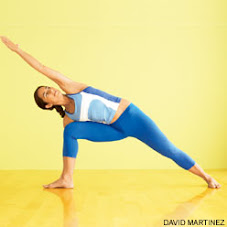
Some women are years away from menopause. Others are staring it right in the face. There is perimenopause and postmenopause. You might want to take a look at the following article from YogaJournal.com and start adding some of these poses to your practice.

There are some pretty basic poses that will help with symptoms such as insomneia, headaches, mood swings, depression, and bone loss.

The site is: http://www.yogajournal.com/poses/finder/therapeutic_focus/t_menopause

The poses include several that we do in class on a regular basis including:

Big Toe Pose,

Triangle,

Standing Forward Bend,

And Seated Forward Bend.

It is never too late to start taking better care of yourself. Do it today!

Questions about Yoga that you may have

Practicing Yoga

How should I prepare for a practice session?
You should take care that you do not eat a heavy meal before practicing. You should wear comfortable clothes. Use a towel or yoga mat to help cushion and support your body.


Why do we need to be relaxed before beginning yoga?
Relaxation is one of the most enjoyable and beneficial parts of my yoga practice. It helps calm my mind and relieve the stress of daily living. Relaxation and prayer before you begin will help you get into the proper state of mind. Take a few minutes to relax between each series of postures to help re-center yourself and feel the benefits of the postures you've completed.


Do I need special equipments to practice yoga?
Your body is really the most important 'equipment' that you need. Practicing Yoga can be practiced almost anywhere, without special equipment, and by people of all ages. You basically do not need anything to Practice Yoga. The important thing is the attitude - a big heart and a small ego. There are some supplies that are basic and which can help you be more comfortable and safer in your practice.


What equipments or props do I need?
The most basic equipment for yoga is the yoga mat. Using a mat, or towel will provide support and added comfort when you do lying or sitting positions.

The beauty about having one's own mat is the fact that purely by laying it down on the studio floor, beach, back yard, park - or wherever - the intention to focus, become immersed and attuned to your yoga space in preparation for practice is signified. It sharpens the focus and awareness to what you are about to do and helps create just the right mental state for a session. A sticky mat is recommended highly as it helps to ensure that you're able to perform certain poses safely, with minimum risk of slipping.


Why do I need props?
The yoga props help you achieve the proper alignment, balance and make the pose a bit easier. The use of props also minimizes the strain and supports your muscles, thus allowing you to save your energy by exerting less effort on a pose. The props provide support, enabling you to do the poses that ailments or old age may prevent from doing.


What kind of clothes should I wear?
While practicing yoga it's recommended to wear loose or stretching clothes. In other words, yoga clothes you choose should be comfortable and functional and not distract you from your practice.

Natural fabrics, like cotton, are preferable, as your skin doesn't breathe well under lycra. This is especially important if you sweat a lot. If you wear a sweatshirt, wear a t-shirt underneath in case you become too warm. Wear comfortable shorts or leggings for supportive, yet unrestricted, movement. Practicing Yoga pants or shorts are a great idea.

Practicing Yoga is traditionally practiced bare foot- this gives you a sense of close contact with the ground and allows the muscles in you feet to operate freely. However, socks or soft-shoes can be put on.

Avoid wearing perfume or other scents.


Should I eat before or after Practicing Yoga?
You should avoid meals at least two hours before class. Snacks and light meals are okay. It is best to practice yoga on an empty stomach. It's best not to eat 1½ hours before class, mainly because it's uncomfortable to have food in the stomach when you're bending, twisting, and exerting yourself. If you need to eat before a class, give as much time as you can and eat lightly; yogurt and fruit for example.


Can I drink water during Practicing Yoga?
Yes, definitely. In fact, you should drink plenty of water before, during and after yoga practice. During your practice, your body will likely sweat and release toxins. Water is necessary to help you flush out the toxins and replenish any lost fluids. After your practice you will probably be thirsty, so cool, refreshing water will seem like a wonderful reward after all your hard work.


Can I listen to music?
Though music is found to have a relaxing effect on us, yoga in itself is a relaxing method. It is generally recommended to practice in a calm and serene environment.


Why do they always have savasana (final relaxation) in a yoga class?
Savasana is one of the most important poses. It's the reward for all the hard work you've done. It allows your breath to normalize and lets the oxygen flow through the relaxing body. Savasana lets prana (energy) to balance out throughout your body. Never skip your final relaxation!


What is the benefit of breathing during yoga?
The power of breathing practice or pranayama to change your state of mind is extremely strong. Also, you use your breath to heat your body from the inside out. Think of it as lubricating your muscles as you use them.

Sunday, July 6, 2008

The Eyes of the Blind Shall be Opened

Today, in church, one of our ministers preached a sermon titled "A Leap in the Mud". The story from the Bible can be found in John 9:1-12. It's the story of the blind man who Jesus healed by taking his saliva and dirt and making mud. Jesus applied the mud to the blind man's eyes and then asked him to go the sea and wash the mud off. When the man did so, he could see perfectly. Jesus healed him. Why did Jesus not just cure the man straight away? Why did he ask the man to go to the river to wash off the mud? I wonder...

When I was in college at Mercer University, I was lucky enough to be in the college choir. Justine, one of the girls in our choir was blind. I would see her across campus leaning on a friend, walking with a cane, or being led by a guide dog and I felt so sorry for her. I wondered if she was always blind. I marveled at how she was able to take classes, get to church, and have a normal college life.

One Christmas, our Mercer choir performed Handel's Messiah at the Grand Opera House in Macon. The house was packed. When it came time for Justine to sing her solo, another choir member led her to the microphone. Justine looked so fragile and frail standing on that enormous stage. She stood there for a moment waiting. Every eye in the house was on her. I know I was holding my breath and imagine most everyone was right there with me.

She began to sing and it was as if an angel had descended from Heaven to deliver a message to us. We were mesmerized. I remember thinking, God gave Justine this beautiful voice so that people could see and feel His love. It was humbling for me. In a moment, in the twinkling of an eye, I was and will be forever changed.

Since that time, I've had opportunities to see Handel's Messiah again and again. Every time I hear it, I close my eyes during the performance. It helps me remember Justine and the way I felt when I heard her sing. In my temporary blindness, I truly listen way down deep with my heart. Distractions fade away. I'm like the blind man walking to the river hoping that the mud applied to my eyes by Jesus might finally wash off my blindness.

In Isaiah 35:6, it says "Then the eyes of the blind shall be opened, and the ears of the deaf shall be unstopped." If we are able to see that God is perfect in his love for us, then haven't we opened our eyes to an all powerful, all knowing, and completely merciful God.

My days of college are long past, but the Justine moments remind me that I have the choice to be able to experience and see God's love every day. It makes me so joyful to think of His grace allowing the blinders to be removed from our eyes. Maybe Jesus put the mud on the man's eyes so he would have to travel to the sea trusting that God would show him the path. That God has the map and we just have to believe he will guide us to where we need to travel. Justine knew that when she sang her solo - she had to trust God to give her strength to live each day in complete darkness. Now, it is my turn to trust that He can lead me to where my eyes shall be opened.

Wednesday, July 2, 2008

That's a Great Question - Why do I teach Yoga in a Christian Church?

The other night, my husband and I were having a lovely dinner with another couple who had invited us over. The evening was wonderful - great food, lively conversation, and relaxation. The husband, a devoted Christian, was asking me how I got interested in yoga and more specifically in teaching yoga. He understood yoga to be rooted in Hinduism and Buddism and was trying to get his head around the fact that I taught yoga in a Christian church to Christians. How exactly does a Christian teach yoga he wondered?

The question begs an answer. Teaching yoga, for me, is not just an opportunity to teach others about the physical benefits of stretching and becoming stronger through the practice of yoga. Sure, that is a part of what I hope to accomplish. But more than that, is the opportunity for me to teach others to slow down and listen to our Father, to break out of the distractions and craziness of daily life, and prayerfully listen to His voice. You can't do that if your always distracted and busy. You need some carved out quiet time and that's what is carved out in class.

Prayer, and scripture from the Bible are in my classes. We focus on being grateful and joyful to God for our health and wellness. We practice glorifying Him, not ourselves when we give thanks for our accomplishments. It is amazing to me how much we take for granted, so we slow down and thank the Lord for his many blessings.

If we sit still, and we ask for God to come into our hearts, He will.

That's why I teach yoga - to offer people an opportunity to "Wait for the Lord; be strong and take heart and wait for the Lord"(Psalm 27:4). It's a discipline that starts and then grows daily with each time we open our hearts to His Word as we do our daily practice.

Also, because it's hard to know when to stop "doing" for everybody else, yoga class offers us to take a time out from the multi-tasking we sometimes call life. Yoga class for me reminds me of what the flight attendants say about putting on our oxygen masks before a commercial plane flight. "If oxygen levels are low, the mask above you will drop from the overhead. Make sure to secure your own mask before assisting others."

It isn't selfish if we think about it thoughtfully. We can't help anyone else if we can't breathe yourself. And from a perfectly practical point of view, it stands to reason that the healthier we are, the better we are able to serve others.

So, that's why I teach yoga.

Have we learned to be still in God's presence? Have we ceased our work long enough to receive God's gifts? How can we if we don't put the oxygen mask on once in awhile?

Thursday, May 15, 2008

Prayers for Mothers - This is one that hit home with me.

I was looking around for a prayer for mothers and found the following prayer. It was published on the following site and no author is listed: http://www.creighton.edu/CollaborativeMinistry/Mothers/#Laundry

Prayer While Doing Laundry

I find you so close to me right here, dear Lord. Surrounded by the dirt and scattered clothing of my family, I find this an ideal spot to pray with you.

No one comes near here so it is quiet, and it gives me a chance to reflect on the many blessings of my life.

As I pick up their clothing and sort it, I ask you to give each of them what is needed most in their lives.

I fill the washer with my husband's shirts and socks, and ask that you bless him as he wears them to work each day. Give him the grace to see that his work is holy and open his eyes to see the sacredness of each moment of life.

As I sort the tiny socks or the overalls of the children, I smile and remember how blessed I am to have them in my life.

I sort the larger teenage clothing and wonder at how fast these clothes have become larger sizes - and how quickly children grow up. I ask your help as I guide them through each new phase of their lives.

Give me a love that is endless, a heart that forgives them and the humility to ask for their forgiveness when that is right. Help me keep them from danger, and help me to let go and trust you when it is time to do that.

I try so hard to be perfect but lead me to remember that it is here in the smudged, disorganized and disheveled part of life that I find you the nearest.

Thank you, dearest Lord, for so much grace in my life!

Bow - for better posture

The pose Dhanurasana (Bow) extends the body back into the shape of a bow as the arms reach back straight and taut, forming the "string" of the asana. Done properly, Dhanurasana is a superb back strengthener that can help vanquish the postural enemy of rounded shoulders.


Arching the body backward opens the chest and provides a powerful stretch for the front of the shoulders and the quadriceps—a wonderful antidote to all the time we spend "crunched" forward in daily life. Regular practice of this pose helps keep the spine flexible and counters the tendency to slump forward.


Like all other backbends, Dhanurasana is dynamic and energizing—stretching the front body increases the flow of blood to the digestive tract and enhances the efficiency of the stomach, liver, and intestines, while contracting the back body stimulates the kidneys and adrenals. But it can be so invigorating that if you suffer from insomnia, you should not practice it late in the day.


Mind the Back
Dhanurasana enhances the back-strengthening and chest- and abdomen-stretching effects of the other prone (belly down) backbends—such as Bhujangasana (Cobra) and Salabhasana (Locust)—which are often used as preparatory poses.


Although catching the feet or ankles integrates the posture, it can also compress the back. For this reason, it's important to create space between the vertebrae and to stay as relaxed as possible while you're in the pose.

You can also modify Dhanurasana by reaching the arms back without catching the ankles or by using a strap. So start with the modified versions and stay with them as long as you need to. Don't worry about catching the ankles if this puts pressure on your knees or lower back.


The key to any yoga pose done properly are "steadiness" and "ease." If you don't feel steady and at ease in this pose, or any other, back off to easier versions until you do. Challenge yourself but don't strain. You do not have to catch your feet or ankles to gain great benefit.


Warm the Body
Since Dhanurasana provides an intense stretch of the shoulders, spine, and thighs, warm up these areas properly. Begin in Balasana (Child's Pose) with arms extended forward, and bring awareness to the lower back, breathing into your back ribs and dropping your hips toward your heels. Release head, arms, and shoulders. On an inhalation, come onto all fours. Then, on an exhalation, stretch back to Adho Mukha Svanasana (Downward-Facing Dog Pose). Inhale back to all fours and exhale to Balasana, repeating this series of linked poses five or six times, synchronizing the movements with your breath.


Then move into Anjaneyasana (Crescent Pose) to open up the front of your thighs. From Downward Dog, step your right foot forward between your hands, with the toes in line with your fingertips. Bring your hands to your hips and drop your pelvis down so that your front knee bends forward, tracking directly over your toes. Add a shoulder stretch by clasping your hands behind your back—keep a "micro-bend" in the elbows—and bring your clasped hands up away from your tailbone. Then bring your hands back to the floor on either side of your foot, and step into Downward Dog. Repeat the lunge on the other side.

Monday, April 28, 2008

Serenity Prayer

When you are feeling stressed or overwhelmed:


God, grant me the serenityto accept the things I cannot change;the courage to change the things I can;and the wisdom to know the difference.

Reinhold Niebuhr